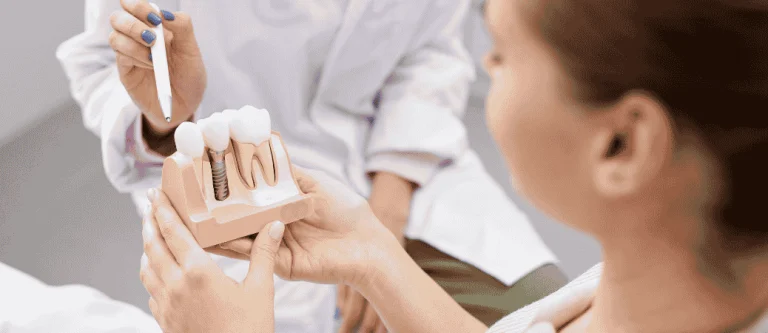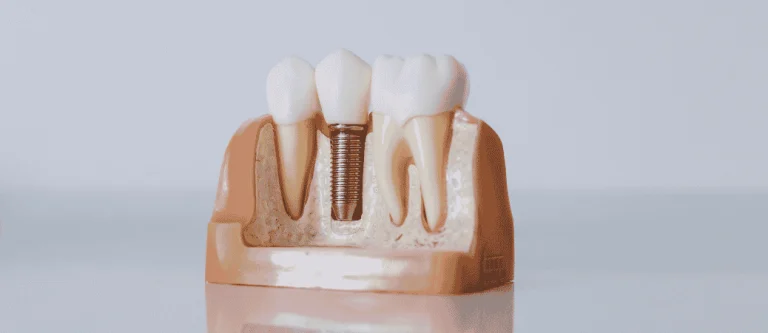



Many people worry that they’ve passed the age where dental implants are an option. If you’re in your 60s, 70s, or beyond and asking yourself whether it’s too late, you’re asking the right question at exactly the right time.
There is no upper age limit for dental implants; what matters is your overall health, bone quality, and ability to heal, not the number of candles on your birthday cake.
While some things do change as you age, dental implants work just as well after 60 when you’re in good health and work with an experienced team.
The truth is that older adults are often excellent candidates for implants.
Your body may heal a bit differently than it did decades ago, but with the right preparation and care, you can enjoy the same long-term benefits as younger patients.
Key Takeaways
- Age alone does not disqualify you from getting dental implants at any stage of life
- Your overall health and bone quality matter more than your age when determining eligibility
- Dental implants can last decades with proper care and offer better stability than traditional dentures
Explore dental implants after 60 and see how they can support a stronger, healthier smile.
Age Versus Health: Who Is Eligible for Dental Implants?
Your overall health matters more than the number of candles on your birthday cake.
While many seniors worry they’ve aged out of dental implants, doctors focus on bone density, gum health, and medical conditions rather than age alone.
Is There a Maximum Age Limit?
There’s no cutoff age that automatically disqualifies you from getting dental implants for seniors.
Studies comparing patients over 65 with younger groups found only a 2% failure rate across both age ranges over 10 years.
Many adults in their 70s and 80s successfully receive implants.
What your periodontist or implant dentist evaluates during your dental implant consultation is whether your body can handle the surgery and heal properly afterward.
Age alone doesn’t disqualify you from being a candidate. Your physical condition and ability to undergo treatment safely determine eligibility.
Even participants over 80 years in research studies experienced only slightly higher complication rates compared to younger patients.
Health Factors That Matter Most
Your implant dentist will review several key health indicators during your implant consultation:
Bone Density and Quality
- Sufficient jawbone strength to support the titanium post
- Adequate bone height and width at the implant site
- History of bone loss or osteoporosis
Gum Health
- Absence of active gum disease or periodontitis
- Healthy tissue that can heal around the implant
- Good oral hygiene habits
Medical Conditions
- Controlled diabetes (uncontrolled diabetes slows healing)
- Heart health and cardiovascular conditions
- Immune system function
- Blood clotting ability
Smoking significantly affects success rates because it slows healing. Your ability to maintain proper oral hygiene after the procedure also plays a major role in long-term success.
When Implants May Not Be Recommended
People with unmanaged medical conditions or severely compromised bone may not qualify as good candidates. Uncontrolled diabetes creates a higher risk of infection around the implant site.
Active cancer treatment, recent radiation therapy to the jaw area, or certain autoimmune diseases can affect healing. Heavy tobacco use remains one of the strongest risk factors for implant failure.
If you take medications that affect bone metabolism or immune function, your doctor needs to evaluate whether implants for seniors are safe for you.
Severe bone loss might require additional procedures like bone grafting before placing implants, which adds time and cost to treatment.
Your periodontist may suggest alternatives if healing concerns outweigh potential benefits. However, many conditions can be managed or improved before proceeding with dental implants.
Schedule a consultation for dental implants in Liberty, North Carolina.
The Dental Implant Process for Seniors
The dental implant procedure involves three main phases: diagnostic planning with advanced imaging, surgical placement of the implant post, and a healing period where the implant fuses with your jawbone.
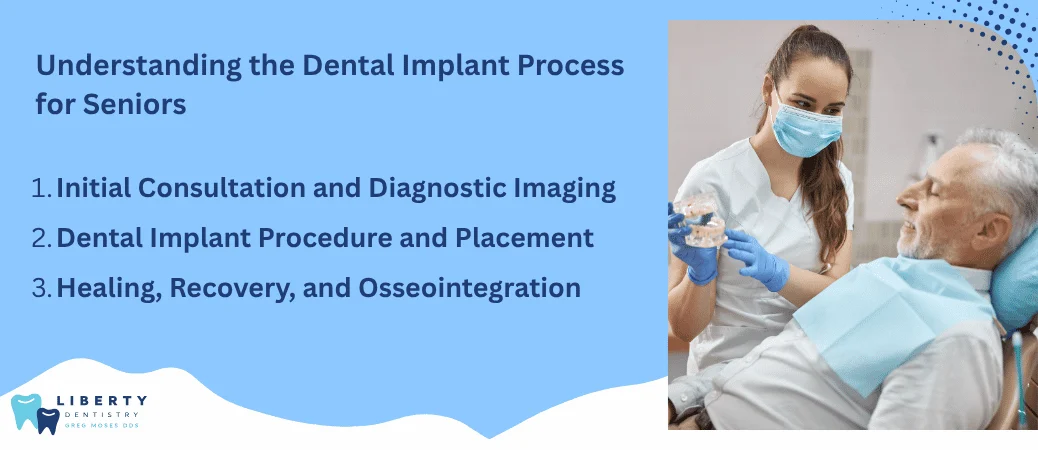
Initial Consultation and Diagnostic Imaging
Your first appointment focuses on evaluating whether you’re a good candidate for dental implants. Your dentist will examine your mouth, review your medical history, and discuss any medications you take.
CBCT imaging or 3D imaging is typically used instead of regular dental x-rays. This advanced technology creates a detailed picture of your jawbone structure, showing bone density and identifying nerves and sinuses.
The images help your dentist plan exactly where to place each artificial tooth root.
Your dentist will also check for gum disease or infections that need treatment first.
If you have conditions like diabetes or take medications that affect healing, your dentist will work with your doctor to create a safe treatment plan.
Some patients need bone grafting before implant placement, which your imaging will reveal.
Dental Implant Procedure and Placement
Dental implant surgery usually happens under local anesthesia, though sedation options are available if you prefer. Your oral surgeon makes a small opening in your gum to access the jawbone.
The implant placement involves inserting a titanium post into your jawbone. This post acts as your new tooth root.
The procedure typically takes 1-2 hours per implant. Most patients report minimal discomfort during the actual surgery.
After placing the implant, your surgeon may place a temporary protective cap over it. Your gum tissue is then closed with stitches.
You’ll receive detailed instructions for managing any swelling or discomfort, which usually peaks within the first 48 hours.
Healing, Recovery, and Osseointegration
Osseointegration is the process where your jawbone grows around and bonds with the titanium implant. This typically takes 3-6 months, though healing can take several months depending on your individual health.
During this time, you’ll eat soft foods and follow careful cleaning instructions. Your age doesn’t necessarily slow this process down.
Once osseointegration is complete, you’ll return for abutment placement. This connector piece attaches to your implant and holds your final crown.
After your gums heal around the abutment (about 2 weeks), your custom crown is attached.
Contact our Liberty, North Carolina team to ask about implant options.
Bone Health, Gum Support, and Common Challenges After 60
Your jaw and gums naturally change as you age, which can affect your ability to get dental implants.
Bone density often decreases, gum tissue may weaken, and health conditions become more common in older adults, but solutions exist for these challenges.
Bone Loss and Jawbone Density
Bone loss in your jaw happens naturally over time, especially after you lose teeth. When a tooth is gone, the jawbone in that area no longer gets stimulation from chewing. This causes the bone to shrink and lose density.
After age 60, this process can speed up. You might have less bone volume than younger patients, which makes it harder to place standard implants.
Your dentist will take X-rays or CT scans to measure your jawbone density before recommending implants.
The amount of bone you need depends on the type of implant. Standard implants require adequate height and width of healthy bone to stay secure.
Bone Grafting and Alternative Implant Options
If you don’t have enough bone, bone grafting can build up your jawbone. This procedure adds bone material to areas that need more support. The graft takes several months to heal before implants can be placed.
You might also consider alternative options if grafting isn’t right for you. Mini dental implants are smaller and need less bone than standard implants.
They work well for people with moderate bone loss.
Zygomatic implants anchor into your cheekbone instead of your jaw. These expanded treatment options work for patients with severe bone loss in the upper jaw.
The Importance of Gum Health
Your gums support your implants just like they support natural teeth. Healthy gums need to be free from infection and inflammation before you can get implants.
Gum disease is more common in older adults and can cause implant failure. You’ll need treatment for any gum problems before surgery.
Your dentist will check for periodontal disease and make sure your gums are strong enough to heal properly.
After you get implants, keeping your gums healthy prevents infection around the implant site. Brush twice daily, floss carefully, and see your dentist regularly for cleanings.
Comparing Tooth Replacement Solutions for Older Adults
Older adults have several tooth replacement options beyond traditional dentures, each offering different levels of stability, cost, and permanence.
Implant-supported solutions provide superior function and stability compared to removable options, though they require a higher upfront investment
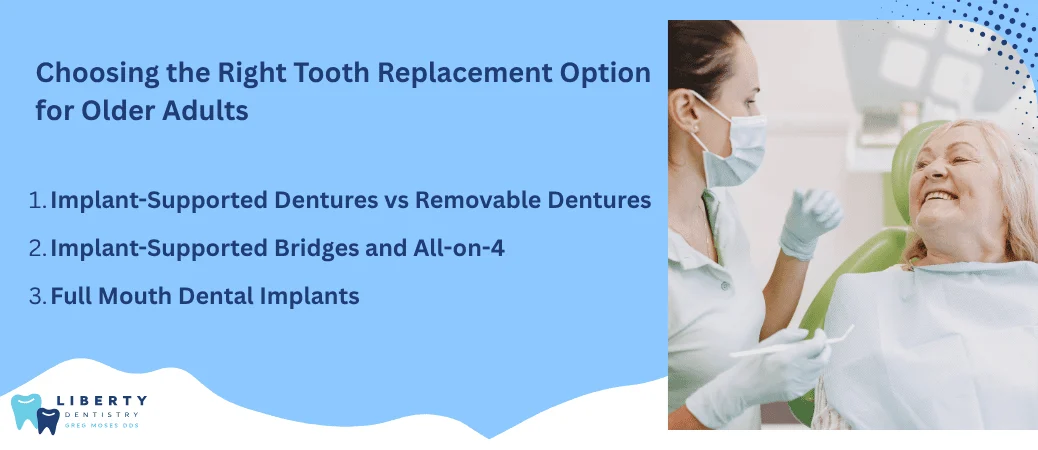
Implant-Supported Dentures vs Removable Dentures
Implant-supported dentures attach to titanium posts in your jawbone, giving you a much more stable fit than removable dentures. You won’t need adhesives or worry about slipping while eating or talking.
These dentures snap onto the implants but can still be removed for cleaning.
Removable dentures rest on your gums and may require adhesive to stay in place. They’re less expensive upfront but often need adjustments or replacements every 5-7 years.
Many people find removable dentures uncomfortable and limiting when eating certain foods.
The main trade-off is cost versus stability. Implant-supported dentures typically cost more initially but provide better chewing function and help prevent bone loss in your jaw.
Traditional removable dentures are more affordable but may become loose over time as your jawbone changes shape.
Implant-Supported Bridges and All-on-4
An implant-supported bridge uses 2-4 implants to hold several replacement teeth in a fixed position. Unlike removable dentures, you can’t take these out yourself. They feel and function more like natural teeth.
The All-on-4 technique replaces an entire arch of teeth using just four strategically placed implants.
This approach works well if you have some bone loss because the back implants are angled to maximize contact with existing bone. You can often get temporary teeth the same day as your surgery.
Both options give you permanent teeth that don’t slip or require removal for cleaning. You brush and floss them like natural teeth.
The All-on-4 system typically costs less than individual implants for each tooth while still providing excellent stability and function.
Full Mouth Dental Implants
Full mouth dental implants involve placing individual implants for each missing tooth, creating the most natural-looking and functioning result.
This approach requires sufficient jawbone density and can take several months to complete as each implant needs time to integrate with your bone.
The process is more involved and expensive than other options, with costs potentially reaching high amounts for a complete restoration.
However, full mouth implants can last decades with proper care, making them a long-term investment.
Your dentist might recommend bone grafting if you don’t have enough jawbone to support individual implants.
This adds time and cost to the process but makes implants possible for many people who wouldn’t otherwise qualify.
Benefits, Longevity, and Success Rates in Seniors
Dental implants in older adults are safe and effective, with success rates that match younger patients and benefits that can significantly improve your daily life.
Understanding what to expect from your implants and how to care for them helps you make an informed decision about this investment in your oral health.
Dental Implant Success Rate in Older Adults
The dental implant success rate is 97% at 10 years and 75% at 20 years, which shows that these replacements last a long time. Age itself doesn’t increase your risk of failure.
Research comparing 400 patients over 65 years with younger groups found only a 2% failure rate across both groups over 10 years.
Even patients over 80 years experienced only slightly higher complication rates. This means your age won’t hold you back from successful treatment.
The most common reasons for implant failure include infections, especially if you have diabetes, and slower healing if you smoke.
Mechanical issues like loose screws can also occur. But these complications are rare when you follow proper care instructions.
Benefits of Dental Implants for Quality of Life
Dental implants offer you several advantages over dentures or bridges. They help you chew food properly, which supports better nutrition and digestion.
The implants also prevent further jawbone deterioration that happens when you lose teeth.
Your facial appearance improves because implants fill out your cheeks and support your lips like natural teeth do. They stabilize neighboring teeth and keep them from shifting into gaps.
Unlike dentures, you don’t need to remove implants for cleaning or worry about them slipping while you eat or talk. They feel and function like your natural teeth.
This permanence helps you maintain your mouth health and keeps your smile looking natural.
How to Support Implant Longevity
Taking care of your implants properly helps them last as long as possible. You need to brush twice daily and floss around the implant just like you would with natural teeth.
Regular dental check-ups let your dentist spot any issues early.
Key care practices include:
- Following all post-surgery healing instructions carefully
- Attending all scheduled follow-up appointments
- Reporting any looseness or pain right away
- Avoiding smoking, which slows healing
- Managing conditions like diabetes that affect healing
The healing process takes several months, so patience is important. Your bone needs time to fuse with the titanium post.
During this time, maintaining good oral hygiene prevents infections that could cause failure.
What to Expect: Costs, Risks, and Preparing for Your Consultation
Understanding the financial investment, possible complications, and what questions to ask will help you feel ready for your first appointment.
Treatment costs vary based on your specific needs, and knowing potential risks helps you make a smart choice about moving forward.
Cost of Dental Implants for Seniors
The price you’ll pay depends on how many implants you need and what prep work is required. A single implant typically costs between $3,000 and $6,000.
If you need a full arch of teeth, prices range from $18,000 to $36,000 per arch.
Most dental insurance plans don’t cover implants fully. Some plans may cover part of the crown or other components.
You might qualify for financing options that let you pay over time instead of all at once.
Additional costs may include bone grafting if you’ve lost jaw bone, tooth extractions, or imaging scans. Ask your dentist for a complete breakdown during your consultation so you know the total investment upfront.
Potential Risks and How to Minimize Complications
Like any surgical procedure, dental implants carry some risks. These include infection, delayed healing, nerve irritation, or allergic reactions (though rare).
Your health conditions affect your risk level. Uncontrolled diabetes, recent heart problems, or smoking can slow healing. If you take medications that affect bone healing, your dentist may need to adjust your treatment plan.
To reduce complications, follow all pre-surgery and post-surgery instructions carefully. Stop smoking several weeks before and after the procedure.
Keep your blood sugar controlled if you have diabetes. Tell your dentist about all medications and health conditions during your first visit.
Questions to Ask at Your Dental Implant Consultation

Bringing the right questions helps you understand what treatment involves and whether it fits your needs. Ask about your eligibility based on your specific health situation and bone quality.
Find out how long the entire process takes from start to finish. Ask what happens if an implant doesn’t integrate properly with your bone. Get details about pain management during and after surgery.
Important questions to cover:
- How many implants do I need for my situation?
- What is the total cost including all procedures?
- What financing or payment options are available?
- How long is the recovery period?
- What are my alternatives if implants aren’t right for me?
Request information about the dentist’s experience with patients your age and their success rates.
Frequently Asked Questions
Age alone doesn’t determine whether you can get dental implants, and many people in their 70s, 80s, and even 90s receive them successfully.
The factors that matter most are your overall health, bone quality, and ability to heal rather than the number on your birthday cake.
Is it safe to get dental implants after age 60?
Yes, dental implants are safe for seniors when you’re in good overall health. Studies show that dental implants have a success rate of over 95% in adults with proper care.
Your safety depends more on managing chronic conditions like diabetes or heart disease than your age. Your dentist will review your medical history and medications to create a safe treatment plan.
The procedure is performed with appropriate sedation and monitoring. Most older adults recover well when they follow their dentist’s aftercare instructions.
At what age do dentists usually recommend stopping dental implants, if ever?
There is no upper age limit for dental implants. Dentists don’t use a specific age cutoff to determine who can receive treatment.
What matters is your clinical factors, not your birth year. Your dentist will evaluate your bone quality, overall health, and ability to heal.
Some people in their 90s are excellent candidates while some younger people may not qualify. Each case gets reviewed individually based on health factors.
Can someone in their 80s still be a good candidate for dental implants?
Yes, many people in their 80s receive dental implants successfully. Patients in their 80s regularly get implants when they have sufficient bone and reasonable health.
Your candidacy depends on factors like controlled blood sugar levels, adequate bone density, and healthy gums. If you can safely undergo a minor surgical procedure, age won’t hold you back.
Your dentist may coordinate with your primary care doctor to ensure your medical conditions are well-managed before treatment. This teamwork helps ensure the best possible outcome.
Can a person in their 90s get dental implants, and what factors matter most?
People in their 90s can get dental implants if they meet the health requirements. Age alone doesn’t disqualify you from receiving implants at any age.
The most important factors are your bone health, healing ability, and overall medical condition. Your dentist will look at whether you have controlled chronic diseases and adequate jawbone to support the implants.
Your medications also matter since some drugs can affect bone healing. Your care team will review everything during your consultation to determine if implants are right for you.
What options are available for seniors who have bone loss but want dental implants?
You may still qualify for implants even with bone loss. Your dentist might recommend bone grafting or other preparatory procedures to build up your jawbone before placing implants.
Some advanced techniques work with limited bone structure. These specialized approaches can help patients who wouldn’t qualify for traditional implant placement.
Alternative implant solutions exist for different anatomy and bone conditions. Your dentist will discuss which option fits your specific situation and goals.
How much do dental implants typically cost for older adults, and are there ways to make them more affordable?
Dental implant costs vary based on how many implants you need and any preparatory work required. Full-mouth treatment ranges from $18,000 to $36,000 per arch at many implant centers.
Third-party financing options help make monthly payments more manageable for many patients. Some dental practices offer payment plans that spread the cost over time.
Insurance discounts may be available even if your plan doesn’t cover implants directly. Some centers provide discounts up to $5,000 when you show proof of insurance coverage.