



A crown that felt fine for months and now aches is worth taking seriously, but it is rarely a mystery once a dentist looks closely.
When your dental crown hurts months later, the most common reasons include new decay at the crown’s edge, changes in your bite, teeth grinding, a crack in the underlying tooth, nerve inflammation or infection, and gum recession.
Each condition can cause similar symptoms, so an exam is needed to identify the problem.
The good news is that delayed crown pain does not automatically mean the crown has failed.
Some cases improve with a bite adjustment, while others may need restorative dentistry, such as root canal treatment or a replacement crown. Finding the cause early can help preserve more treatment options.
At Liberty Dentistry, a big part of each crown visit is sorting out which group your tooth falls into before suggesting any treatment.
Key Takeaways
- New crown pain after months of comfort points to a change in the tooth, gum, nerve, or bite.
- How and when it hurts helps guide the exam, though only testing and X-rays confirm the cause.
- Treatment ranges from a quick bite adjustment to root canal care, and early visits keep it simpler.
What Causes a Crown to Start Hurting Months Later?
Your crown is a cap, and the living tooth, roots, and gums under and around it can still change over time.
Delayed pain comes from four main sources: decay or loose cement at the edge, extra force from your bite or a crack, nerve inflammation or infection, and gum recession.
Decay or a Loose Crown at the Edge
The crown itself can’t get a cavity, but the tooth beneath it can. Decay tends to start at the margin, the thin line where the crown meets your natural tooth near the gum.
Plaque collects there, especially if flossing around the crown is tricky.
Over the years, the cement that seals the crown can also wear down. A tiny gap lets bacteria and food slip underneath, where you can’t brush. You might notice:
- Sensitivity to sweets, cold, or heat
- A bad taste or odor near the tooth
- Food catching at the gumline
- A crown that clicks or shifts when you chew
Early decay often causes no pain at all, which is why routine X-rays matter. If you want a refresher on how cavities form and spread, the 411 on cavities covers the basics.
Bite Changes, Grinding, or a Cracked Tooth
A crown that fit your bite perfectly when placed can start taking too much pressure later. Teeth drift over time.
A new filling, a lost tooth, or a crown on a nearby tooth can change how your upper and lower teeth meet.
Grinding and clenching add heavy, repeated force, often at night. That pressure irritates the ligament holding the tooth in its socket, and the tooth feels sore or bruised. Morning soreness and tired jaw muscles are common clues.
If you snore or wake up tired, grinding sometimes links to sleep problems, and these snoring and sleep apnea signs are worth a look.
The tooth under a crown can also crack. A crack usually brings a sharp, quick jolt when you bite down or let go. Cracks are hard to see, even on X-rays, so your dentist may need several tests to find one.
Pulp Inflammation, Infection, or Root Canal Problems
Unless your tooth already had a root canal, the nerve inside it (the pulp) is still alive. It can become inflamed months or years after a crown, a condition called pulpitis.
Deep decay, an old filling under the crown, a crack, or the original trauma of shaping the tooth can all set it off.
Mild inflammation sometimes calms down on its own. More serious inflammation does not, and the nerve can die and become infected.
That infection can spread to the bone at the root tip and form an abscess.
Teeth that already had a root canal can hurt too. A missed canal, a new leak that lets bacteria back in, or a root fracture can bring pain back long after treatment.
Gum Recession and Irritation
Gums can slowly pull away from the edge of a crown. Gum disease, hard brushing, and age all play a part. When that happens, part of the root shows, and roots have no enamel to protect them.
Exposed roots react quickly to cold air and drinks. They also decay more easily than enamel-covered tooth.
Gum inflammation around a crown edge can cause tenderness, bleeding, and redness when you brush or floss.
If your gums bleed often, periodontal treatment can help manage gum disease and reduce the risk of further damage to the supporting tissues.
What Does the Type of Pain Suggest?
The way your tooth hurts gives your dentist a head start, but it points toward possibilities and can’t settle the cause alone.
Biting pain, temperature pain, and throbbing each lean toward different problems, and they often overlap.
Pain When Biting or Releasing Pressure
Pain on chewing is one of the most common crown complaints. It can come from a bite that hits the crown first, a loose crown, a crack, or inflammation around the root.
A few details help narrow it down:
- Sharp pain the moment you bite, gone when you stop: often a high spot in your bite
- A jolt when you release a bite: a classic hint of a cracked tooth
- A dull, bruised ache when you press: can mean the ligament or root tip is inflamed
Pay attention to which foods trigger it. Pain with chewy foods but not soft ones gives your dentist useful information.
Cold Sensitivity or Lingering Heat Pain
How long the pain lasts tells more than how sharp it feels. A quick zing from cold that fades within seconds often comes from exposed root surface or mild irritation.
Pain that hangs on for 30 seconds or more after a cold or hot drink is a different story. It suggests deeper nerve inflammation. Heat sensitivity in particular can signal that the nerve is struggling.
A tip from the chair: time it. Count the seconds the ache lasts after a sip of ice water and tell your dentist the number.
Intermittent Aches, Throbbing, or Swelling
Pain that comes and goes does not mean the problem is minor. Cracks, early nerve trouble, grinding, and loose crowns can all flare up and then quiet down for days.
Throbbing is more concerning. A steady, pulsing ache, or pain that wakes you at night, points toward a nerve that is badly inflamed or infected.
Swelling in the gum or face, a pimple-like bump near the tooth, or a bad taste are signs of infection.
Upper back teeth sit close to the sinuses. A cold or allergy flare can make a crowned upper molar ache, especially when you bend forward.
How Will a Dentist Find the Cause?
A focused exam and imaging can identify most causes of delayed crown pain in a single visit.
Your dentist checks the crown and gums by sight and feel, tests your bite, then uses nerve tests and X-rays to see what’s happening below the surface.
Checking the Crown, Gums, and Bite
Expect questions first. When did it start? What sets it off? Does it linger? Does it wake you? Your answers help separate nerve, gum, and bite problems.
Next comes a close look. Your dentist will:
- Run a fine instrument along the crown edge to feel for gaps or soft decay
- Measure the gum pockets around the tooth
- Check whether the crown moves
- Have you bite on thin colored paper to show where your teeth hit hardest
- Ask you to bite on a small tool, one cusp at a time, to look for a crack
Because pain can feel like it’s coming from the wrong tooth, nearby teeth get checked too. A regular dental exam and cleaning uses many of these same steps, which is why routine visits catch problems early.
Using Sensitivity Tests and Dental X-Rays
Nerve tests show how the pulp responds. A cold swab on the tooth tells your dentist whether the nerve reacts normally, too strongly, or not at all. Tapping gently on the tooth checks for inflammation at the root tip.
X-rays show decay under the crown edge, bone loss, and dark areas at the root that suggest infection. Metal and porcelain crowns block part of the view, so the dentist may take images from more than one angle.
A 3D scan called CBCT sometimes helps with cracks or hidden root problems.
If the nerve or root looks involved, you may see an endodontist, a dentist who focuses on root canals. This guide to different types of dentists explains how specialists fit in.
What Treatments Can Relieve the Pain?
The right fix follows the cause, and many crowned teeth can be saved. Options run from a small bite tweak or night guard to filling decay, replacing the crown, or root canal therapy.
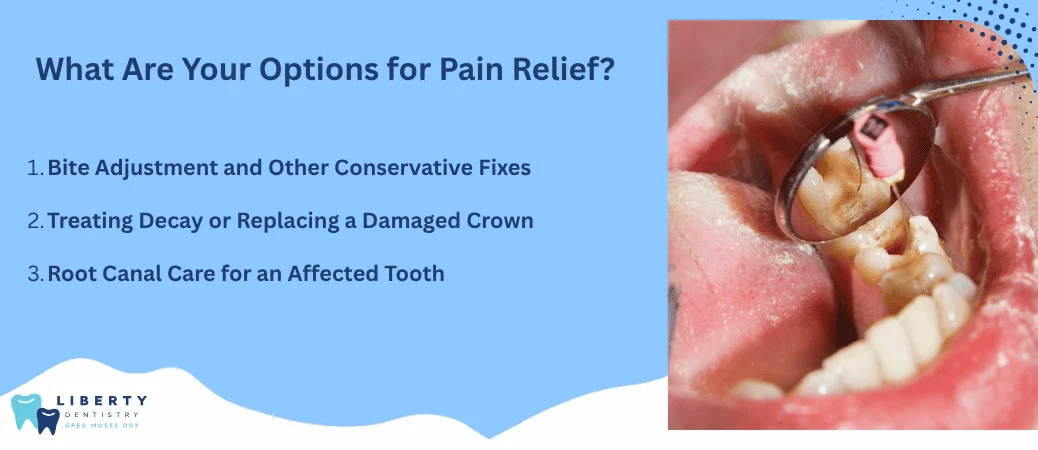
Bite Adjustment and Other Conservative Fixes
If your bite has changed, the dentist can smooth the high spot on the crown or a tooth that hits it. It takes a few minutes, and relief often comes within days.
Before doing this, your dentist should rule out decay, cracks, and infection, since smoothing won’t help those.
Other simple fixes include:
- A custom night guard if grinding is the cause
- Recementing a loose crown when the crown and tooth are still healthy
- Desensitizing treatments or fluoride on exposed root surfaces
- Deep cleaning and better home care for inflamed gums
Small changes at home go a long way here. These flossing tips straight from the dentist help you clean the crown edge where decay starts.
Treating Decay or Replacing a Damaged Crown
Small decay right at the crown edge can sometimes be cleaned out and filled without removing the crown. Larger decay, a crown that’s chipped or cracked, or a poor seal usually means the crown comes off.
The dentist then removes the decay, rebuilds the tooth, and places a new crown. Some offices can make it in one visit; same day crowns and bridges skip the temporary crown stage.
Root Canal Care for an Affected Tooth
When the nerve is badly inflamed or infected, root canal treatment removes the damaged pulp, cleans the canals, and seals them. In many cases the dentist works through a small opening in the existing crown, then patches it.
If the crown is leaking or damaged, a new crown goes on after the root canal. A tooth that already had a root canal and hurts again may need retreatment.
Not every tooth can be saved. A crack that runs deep into the root or extensive decay below the gum may mean tooth extraction is the healthier choice, followed by a replacement like an implant.
When Should You Call a Dentist?
Call your dentist for any crown pain that lasts more than a few days or keeps coming back. Some symptoms need same-day care, and a few simple steps keep you comfortable until your visit.
Symptoms That Need Prompt or Emergency Care
Get seen the same day if you notice:
- Swelling in your gum, cheek, or jaw
- Fever or feeling sick along with tooth pain
- Throbbing pain that wakes you at night
- A pimple-like bump on the gum, or pus
- A bad taste that won’t go away
- A crown that has come off or moves
Swelling that spreads toward your eye or neck, or trouble breathing or swallowing, needs the emergency room. For urgent tooth problems that aren’t life-threatening, emergency dentistry can get you in quickly.
What to Do While Waiting for Your Appointment
These steps ease symptoms but won’t fix the cause:
- Chew on the other side and skip ice, nuts, and sticky candy
- Rinse with warm salt water a few times a day
- Take an over-the-counter pain reliever as the label directs
- Use toothpaste for sensitive teeth if cold bothers you
- Put a cold pack on your cheek for 15 minutes if there’s swelling
Don’t try to glue, pry, or reshape a crown at home. Avoid testing the tooth over and over with ice or hard bites. Jot down when it hurts and how long it lasts so you can share the details.
Getting a Painful Crown Checked Early
Crown pain that shows up months later means something has changed, and early visits give you the most choices.
A bite adjustment, a night guard, or a small filling is far easier than treating an abscess or a crack that has spread.
Your symptoms are useful clues. Biting pain, lingering cold or heat, and throbbing each point the exam in a direction, but they overlap, and only testing and X-rays confirm the cause.
New pain also does not mean you need a new crown. Many teeth recover with simple care.
Before your visit, note what triggers the pain, how many seconds it lasts, and whether it wakes you. Bring a list of recent dental work.
Keeping up with routine general dentistry visits helps catch crown edge decay and gum changes before they hurt.
Frequently Asked Questions
Is it normal for a crown to hurt six months later?
No, a crown that has been comfortable should not start hurting at six months. Mild sensitivity in the first two weeks is common, but new pain later points to decay, a bite change, a crack, or nerve trouble. Book an exam so the cause is found while it’s small.
Why does my crown hurt after two years?
Pain after two years is most often linked to decay at the crown edge, worn cement, gum recession, or a nerve that has slowly become inflamed.
Grinding and shifting teeth can also overload the crown over time. X-rays and a bite check usually sort out which one it is.
Why does a crowned tooth hurt under pressure after a root canal?
A root-canaled tooth has no live nerve, so pressure pain comes from the tissue around the root.
Common reasons include a high bite, inflammation at the root tip, a missed canal, a leak that lets bacteria back in, or a cracked root. Your dentist may suggest a bite adjustment, retreatment, or a referral to an endodontist.
What does it mean when pain under a crown comes and goes?
On-and-off pain often comes from a crack, early nerve inflammation, grinding, or a crown that’s starting to loosen. These can quiet down for days and then flare again.
Coming-and-going pain still deserves an exam, especially if flares get longer or stronger.
Can a permanent crown take months to settle?
Most crowns settle within one to two weeks, and a few teeth stay a little sensitive for several weeks.
Pain that lasts for months, or starts after a comfortable stretch, is beyond normal settling. Ask your dentist to check the bite and nerve.
Does pain months later mean my crown was fitted incorrectly?
Not necessarily, since many causes develop after a well-fitted crown, like new decay, gum recession, grinding, or a crack. A crown that sits slightly high can cause trouble, but that usually shows up within the first weeks.
If you’re in the area, Liberty Dentistry can examine the crown, test the tooth, and explain which fix fits your situation.